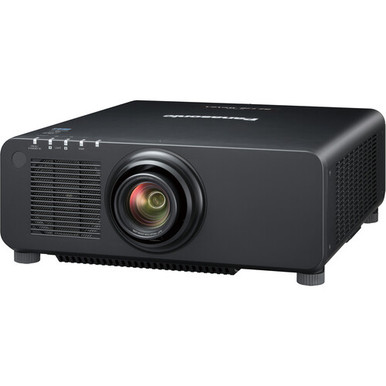
Display System 0.67″ DLP
Native Chip Resolution 1920 x 1200 (WUXGA)
Supported Resolutions Maximum: 4K UHD – 3840 x 2160
Maximum Brightness 6000 Lumens (ISO) 6200 Lumens (Center)
Uniformity 90%
Aspect Ratio Native: 16:10
Dynamic Contrast Ratio 10,000:1, 10,000:1 Lens Focus Manual Powered Lens
Focus Manual Powered
Lens f/1.7 – 1.9 (f = 25.6 – 35.7 mm)
Throw Ratio 1.71 to 2.41:1
Multi-Input Support (PIP/PBP) Not Specified by Manufacturer
Ceiling Mountable Yes
Rear Screen Projection Yes
Remote Yes
Inputs/Outputs 1 x HDBaseT (RJ45) Audio, Control, Data, Power, Video 1 x HDMI (HDMI Type-A) Audio, Video Input 1 x DVI-D Video Input 1 x SDI (BNC) Video Input 1 x SDI (5BNC) Video Input 1 x VGA (DE-15/DB-15) Video Input 1 x Ethernet (RJ45) LAN 1 x 1/8″ / 3.5 mm Mini Remote Input 1 x 1/8″ / 3.5 mm Mini Remote Output 1 x DE-9/DB-9 Remote Input 1 x RS-232 (DE-9/DB-9) Control Input 1 x RS-232 (DE-9/DB-9) Control Output
Light Source Laser Phosphor
Expected Lamp Life Full Brightness: 20,000 Hours Low Brightness: 24,000 Hours
Fan Noise Medium Brightness: 35 dB
Security Cable Lock Slot
Supported Languages English French German Italian Japanese Korean Portuguese Russian Simplified Chinese Spanish
AC Input Power 100 to 240 VAC, 50 / 60 Hz
Power Consumption Full Brightness: 490 W Medium Brightness: 200 W Low Brightness: 160 W
Operating Temperature 32 to 113 F / 0 to 45 C
Operating Humidity 10 to 80%
Dimensions (W x H x D) 19.6 x 7.9 x 22.9″ / 498.0 x 200.0 x 581.0 mm
Weight 48.7 lb / 22.1 kg
Edge Blending Edges of adjacent screens can be blended and their brightness controlled.
Color Matching This corrects color reproduction variations of each projector via computer-based control software.
Digital Image Enlarging Digital zoom up to 10x. Up to 100 images (10 x 10) can be edge-blended to create a large multi-screen image.
The PT-RZ690 features HDBaseT via DIGITAL LINK, 3G-SDI, BNC, VGA, and HDMI inputs to connect to nearly any device. The projector is controllable via the included wired/wireless remote control, DIGITAL LINK via Ethernet, or RS-232 with various control software options. Key Features
WUXGA (1920 x 1200) Native Resolution Includes 1.71 to 2.41:1 Lens
Brightness of 6000 Lumens HDMI, DVI-D, DIGITAL LINK HDBaseT Inputs
Panasonic Quartet Color Harmonizer Realizes High Brightness and Accurate Colors
Expect saturated color and finely expressed detail from 1-chip DLP technology without sacrificing brightness thanks to Quartet Color Harmonizer, an original color-wheel technology with optimized optical design. It precisely modulates light source output according to color requirements.
Brightness of 6000 Lumens Excellent Uniformity for Multi-Screen Projection 1-chip DLP technology allows for great uniformity between adjoining screens. Minimal variation between DMDs allows images from PT-RZ690 series projectors to be easily blended for a more immersive viewing experience.
Panasonic’s System Daylight View 3 technology prevents the picture from washing out in bright light and preserves brightness, contrast, and color, especially in museums and halls. It uses sensor information to adjust sharpness, gamma curves, and color to suit on-site lighting conditions.
Smart Projector Control Geometric Adjustment with Free Grid Correction
4K UHD Signal Input Support Separate LAN and HDBase-T-based DIGITAL LINK terminals allow 100Base-TX- and 10BaseT-compatible control signals via Panasonic, Crestron, AMX, and Extron applications to be assigned to a dedicated LAN connection, freeing the DIGITAL LINK pipeline for video.
Filter-Free Projector Structure with Airtight Optical Block
Heat-sink-based filter-free cooling, dust-resistant architecture, and an efficient airflow path enable deployment of a hermetically sealed optical engine. With dust resistance exceeding the industry’s guidelines, you’re assured of a linear brightness ramp, superior color uniformity, and maintenance-free projection for up to 20,000 hours. These benefits are welcome when the projector is installed in a difficult-to-access location.
The dual-laser optical engine groups diodes into two discrete modules. A redundancy circuit works to minimize brightness- and color-uniformity loss in the unlikely event a diode fails, making supported products ideal for applications where picture presentation must be maintained.
Dual Lasers for Failsafe Reliability Backup Input Setting Protects Picture Display
Dual Lasers for Failsafe Reliability Projectors can be configured to switch instantaneously to a backup input signal should the primary signal be disrupted. This layer of insurance is invaluable in control rooms, security and surveillance applications, and for live events where image projection must not be interrupted.
Dual Lasers for Failsafe Reliability Multi Monitoring & Control Software with Early Warning Functions
Dual Lasers for Failsafe Reliability Manage up to 2048 devices via your network with convenient system map visualization and auto-search of unregistered devices. The free software is available with Early Warning Functions. These enable real time monitoring, abnormality detection, and more.
Dual Lasers for Failsafe Reliability Thanks to two long-lasting solid state laser modules, there are no lamps to replace, and color and brightness decline gradually in consistent, linear fashion. As well as reducing maintenance hassle, out-of-the-box picture quality is preserved for longer.
Dual Lasers for Failsafe Reliability Dynamic Light Control for High Contrast, Light Control directly modulates laser output to achieve high contrast with less power consumption. Digitally controlled frame-by-frame scene-linking modulation ensures precise light output adjustment while accurate contrast is delivered even when bright and dark scenes frequently interchange. Detail Clarity Processor 3
Dual Lasers for Failsafe Reliability This circuitry optimizes the sharpness of each image based on information gathered from four frequency bands of the video signal. The resulting images are expressed with natural, convincing realism.
Dual Lasers for Failsafe Reliability Contrast Sync and Shutter Sync Function, Sync, designed for multi-screen applications, allows dynamic contrast control to be synchronized for consistent picture quality across screens. Individual image brightness is averaged to achieve a unified dynamic contrast value rather than the projectors setting dynamic contrast separately, Dynamic contrast is synchronized across all screens, eliminating step noise in edge-blended areas.
Dual Lasers for Failsafe Reliability Shutter Sync, meanwhile, synchronizes shutter on/off timing. If the shutter functions are not linked, shutter on/off timing varies; when they’re linked, shutter timing is uniform.
Sensors detect color and brightness apparent on screen. The projectors automatically calibrate for a uniform multi-screen image, adding a layer of convenience and cost-saving for long-term events. Multi-Screen Support System
Multi-Unit Brightness and Color Control The projector optimally adjusts multiple screens with edge blending, color matching, and digital image enlargement.
Multi-Unit Brightness and Color Control Edge Blending Edges of adjacent screens can be blended and their brightness controlled.
Multi-Unit Brightness and Color Control Color Matching This corrects color reproduction variations of each projector via computer-based control software.
Single-Cable DIGITAL LINK Connection The laser light source doesn’t require any time to warm up, so images appear almost instantly. There’s also no cool down period when turning the power off, so the projector can be turned on and off any time as necessary. Data Cloning Function
Single-Cable DIGITAL LINK Connection Data cloning allows various settings and configuration data (except passwords, projector name/ID, and network settings) to be copied from a main projector to up to 99 secondary projectors of the same model. Alternatively, the data can be cloned to secondary projectors via your LAN. This feature simplifies and expedites the setup process for multi-unit projection applications.
Select your preferred operational mode to balance brightness decline with brightness output according to the specific requirements of individual applications.
Selectable Operational Modes Geometry Manager Pro Software and Optional Upgrade Kits
Selectable Operational Modes Native Chip Resolution 1920 x 1200 (WUXGA) Supported Resolutions
Selectable Operational Modes Maximum 4K UHD – 3840 x 2160 Maximum Brightness 6000 Lumens (ISO) 6200 Lumens (Center) Uniformity 90%
Aspect Ratio Native 16:10
Aspect Ratio Throw Ratio 1.71 to 2.41:1 Features
Aspect Ratio Multi-Input Support (PIP/PBP)
1 x HDBaseT (RJ45) Audio, Control, Data, Power, Video
1 x HDMI (HDMI Type-A) Audio, Video Input
Input/Output Connectors Inputs/Outputs 1 x DVI-D Video Input, x SDI (BNC) Video Input, x SDI (5BNC) Video Input, x VGA (DE-15/DB-15) Video Input
1 x Ethernet (RJ45) LAN 1 x 1/8″ / 3.5 mm Mini Remote Input 1 x 1/8″ / 3.5 mm Mini Remote Output 1 x DE-9/DB-9 Remote Input 1 x RS-232 (DE-9/DB-9) Control Input 1 x RS-232 (DE-9/DB-9) Control Output General Light Source Laser Phosphor Expected Lamp Life
Input/Output Connectors Inputs/Outputs Full Brightness 20,000 Hours
Input/Output Connectors Inputs/Outputs Low Brightness 24,000 Hours
Fan Noise Medium Brightness 35 dB Security Cable Lock Slot Supported Languages English French German Italian Japanese Korean Portuguese Russian Simplified Chinese Spanish
Fan Noise AC Input Power 100 to 240 VAC, 50 / 60 Hz
Power Consumption Full Brightness 490 W
Power Consumption Medium Brightness 200 W
Power Consumption Low Brightness 160 W
Power Consumption Operating Temperature 32 to 113 F / 0 to 45 C
Power Consumption Operating Humidity 10 to 80%
Power Consumption Dimensions (W x H x D) 19.6 x 7.9 x 22.9″ / 498.0 x 200.0 x 581.0 mm Weight 48.7 lb / 22.1 kg